Origin
"What is arbitration?" "Why choose arbitration?" "How is arbitration conducted?" These are three frequently asked questions from our clients when we handle arbitration cases or matters related to arbitration clauses in practice. Whenever asked by clients, we find it difficult to know where to begin, as the topic is broad and seemingly simple yet not easy to answer. This inevitably leads us to reflect on the development of arbitration.
At the end of the day, arbitration is a set of rules that need to be chosen. Whether telling the story of Chinese arbitration or building a brand for Chinese arbitration, the most important prerequisite for all of this is that arbitration can be chosen by an increasing number of users. If users who hold the power of choice are not aware of sophisticated rule designs and interesting case practices, then the development of arbitration would become like water without a source or a tree without roots.
Based on this, we came up with the idea of introducing arbitration by raising questions from the users' perspective and responding in simple, straightforward language. By enabling users who hold the power of choice to understand arbitration and thus choose it, the development of arbitration in China can achieve steady and long-term progress with the support of practical application.
The Arbitration Law of the People's Republic of China (referred to as the "New Arbitration Law") was revised and adopted on 12 September 2025. The law consists of eight chapters and 96 articles and has come into effect on 1 March 2026. Against the backdrop of the implementation of the new law, we are launching the series "Arbitration in Mainland China Under the New Arbitration Law: Your 50 Questions," using a Q&A format to help users better understand and learn about arbitration.
This series is centered around the process of arbitration and falls into five themes: basis and costs of arbitration, types of arbitration, key participants in arbitration, arbitration procedures and mediation, and enforcement and setting aside of awards. The responses in this series draw primarily from the New Arbitration Law, the current arbitration rules of major arbitration institutions, and judicial practices related to arbitration.
This series is aimed at users from various countries and regions who are interested in arbitration in China, and is published simultaneously in both Chinese and English. Your criticism and comments are welcome.
ABBREVIATIONS AND DEFINITIONS
| Abbreviation |
Definition/Full Name |
|
New Arbitration Law
|
Arbitration Law of the People's Republic of China voted and adopted at the 17th Meeting of the Standing Committee of the 14th National People's Congress on 12 September 2025. Effective as of1 March 2026. |
|
New York Convention
|
The United Nations Convention on the Recognition and Enforcement of Foreign Arbitral Awards (1958)
|
|
CIETAC
|
China International Economic and Trade Arbitration Commission
|
|
BAC
|
Beijing Arbitration Commission/Beijing International Arbitration Court
|
|
2024 CIETAC Rules
|
CIETAC Arbitration Rules revised and adopted by the China Council for the Promotion of International Trade/China Chamber of International Commerce on 2 September 2023. Effective as of 1 January 2024.
|
|
2026 BAC Domestic Rules
|
BAC Domestic Arbitration Rules revised and adopted at the Sixteenth Meeting of the Eighth Session of the Beijing Arbitration Commission on 29 October 2025. Effective as of 1 January 2026.
|
|
2026 BAC International Rules
|
BAC International Arbitration Rules revised and adopted at the Sixteenth Meeting of the Eighth Session of the Beijing Arbitration Commission on 29 October 2025. Effective as of 1 January 2026.
|
|
Mainland China
|
Mainland China excluding Hong Kong, Macau or Taiwan, from a jurisdictional perspective.
|
|
Awards made in Mainland China
|
Foreign-related awards and non-foreign-related awards made in Mainland China
|
|
Foreign-related Awards made in Mainland China
|
Foreign-related arbitral awards made by arbitration institutions inside Mainland China with the Mainland China as the place of arbitration and arbitral awards made by arbitration institutions outside Mainland China with the Mainland China as the place of arbitration
|
|
Non-foreign-related Awards made in Mainland China
|
Arbitral awards without foreign elements made by arbitration institutions inside Mainland China
|
|
Foreign Awards
|
Arbitral awards made by arbitration institutions with a place in a place of a foreign country as place of arbitration
|
|
Hong Kong, Macau and Taiwan Awards
|
Arbitral awards made by arbitration institutions with Hong Kong, Macau or Taiwan as place of arbitration
|
Topic 1: Basis and Cost of Arbitration
Non-Arbitrability
1. What disputes can be resolved by arbitration?
Disputes that can be resolved by arbitration need to meet two requirements: in terms of subjects, the parties should be equal subjects, including natural persons, legal persons and non-legal organisations; in terms of object, disputes must be contract disputes and other disputes over property rights and interests. If there is an arbitration clause in the contract, such tort disputes shall also be resolved by arbitration if the infringing party's act of infringement arises from breaches of contractual terms. On the basis of meeting the above two requirements, the arbitration agreement may also limit the matters in dispute or the scope of arbitration.
The New Arbitration Law does not apply to labor dispute arbitration, rural land contract management dispute arbitration and sports arbitration. The arbitration of these disputes is applicable to the Labor Dispute Mediation and Arbitration Law of the People's Republic of China, the Rural Land Contract Economic Dispute Mediation and Arbitration Law of the People's Republic of China, and the Sports Law of the People's Republic of China.
In addition, according to Article 94 of the New Arbitration Law, Chinese arbitration institutions and arbitral tribunals may handle international investment arbitration cases between investors and host governments.
2. What types of disputes cannot be resolved by arbitration?
You may have heard of the arbitration doctrine of "non-arbitrability," which deals with the types of disputes that are not arbitrable even when there is a valid arbitration clause. These non-arbitrable disputes mainly include: disputes involving identity relations and personal rights and interests, such as marriage, adoption, guardianship, maintenance, inheritance and other disputes; administrative disputes that should be dealt with by administrative organs according to law, but whether disputes under administrative agreements are non-arbitrable or not, needs to be analysed on a case-by-case basis; monopoly civil disputes, monopoly disputes arising from the signing and performance of contracts, are non-arbitrable, which has been clarified in Article 3 of the Interpretation of the Supreme People's Court on Several Issues Concerning the Application of Law in the Trial of Monopoly Civil Disputes; company dissolution disputes, etc.
Arbitration Agreement
3. What are the statutory requirements for an arbitration agreement?
The arbitration agreement shall be in writing, which may be in the form of contract, letter, data message (including telegram, telex, fax, electronic data interchange and e-mail), etc.; the content of the arbitration agreement shall include the expression of the intention to request arbitration, the matters to be arbitrated and the selected arbitration institution.
A complete arbitration agreement, in addition to meeting the aforementioned statutory requirements, shall also include the place of arbitration, the language of arbitration, the applicable law of the arbitration agreement, the number of arbitrators, the qualification requirements and the way of forming the tribunal. The drafting of the arbitration agreement may refer to the template agreement recommended by the arbitration institution after the arbitration institution is selected.
4. If an arbitration agreement is silent on governing law /place of arbitration/language of arbitration, how to determine?
The governing law to the arbitration agreement concerns the determination of the validity of the arbitration agreement and the interpretation of its terms. The governing law to the arbitration agreement may be chosen by the parties. If there is no agreement on the governing law, the law of the place of arbitration shall apply.
The place of arbitration has legal significance, which is used to determine the governing law of the arbitration agreement and procedure (if there is no agreement), the competent court for judicial supervision of the arbitration procedure, the place of the award, etc., which is different from the place of hearing with only geographical significance. For domestic arbitration disputes, the New Arbitration Law still gives the legal meaning of "place of arbitration" to "the place where the arbitration institution is located", that is, the intermediate people's court where the arbitration institution is located carries out judicial supervision. For foreign-related arbitration disputes, the New Arbitration Law clearly regards the "place of arbitration" as the basis for determining the applicable law of arbitration procedure and the court of jurisdiction for judicial supervision.
If there is no agreement on the place of arbitration in the arbitration agreement, the place of arbitration shall first be determined by the parties through consultation. If no agreement can be reached, the place of arbitration shall be determined in accordance with the applicable arbitration rules. If the arbitration rules are silent on this, the place of arbitration shall be determined by the arbitral tribunal according to the circumstances of the case and in accordance with the principle of facilitating dispute settlement. For example, Article 80 of the 2026 BAC Domestic Rules, stipulates that " (1) The seat of arbitration for the domestic cases administered by the BAC is Beijing. The BAC or the arbitral tribunal may determine the seat of arbitration on the basis of the specific circumstances of the case. (2) The arbitral award shall be deemed to have been rendered at the seat of the arbitration. (3) Where the venue of hearing differs from the seat of arbitration, the seat of arbitration determined in accordance with the Rules shall not be affected. " Article 31 of the 2026 BAC International Rules, stipulates that " (1) Where the parties have agreed on the seat of arbitration, the parties’ agreement shall prevail. Where the parties have not agreed on the seat of arbitration, the seat of arbitration for the cases administered by the BAC shall be Beijing, and the seat of arbitration for the cases administered by the Hong Kong Center of the Beijing International Arbitration Court shall be Hong Kong. Where the parties have dispute regarding the seat of arbitration, the BAC or the arbitral tribunal shall have the authority to make a decision on the basis of the specific circumstance of the case. "
If there is no agreement on the language of arbitration in the arbitration agreement, it shall be submitted to the parties for consultation. If no agreement can be reached on the language of arbitration, it shall be determined in accordance with the arbitration rules. Generally, the arbitration institution or the arbitral tribunal shall determine the language of arbitration according to the specific circumstances of the case. For example, Article 84 of the 2024 CIETAC Rules stipulates that " (1) Where the parties have agreed on the language of arbitration,their agreement shall prevail. (2) In the absence of such agreement,the language of arbitration shall be Chinese. CIETAC may also designate one or more language(s) as the language(s) of arbitration after taking into proper consideration of all the circumstances of the case including the language(s) of the contract. The arbitral tribunal,after it is formed,may redesignate the language(s) to be used in the proceedings having regard to the circumstances of the case. (3) If a party or its representative(s) or witness(es) requires interpretation at an oral hearing,an interpreter may be provided either by the Arbitration Court or by the party. (4) The arbitral tribunal or the Arbitration Court may,if it considers it necessary,require the parties to submit a corresponding translation of their documents and evidence into Chinese or other languages."
5. Under what circumstances will an arbitration agreement be considered invalid?
An arbitration agreement shall be deemed invalid if any of the following circumstances exists:
(1) The matters stipulated for arbitration exceed the scope of arbitration prescribed by law;
(2) The arbitration agreement is entered into by a person without civil capacity or with limited civil capacity;
(3) One party compels the other party to enter into the arbitration agreement through coercive means;
(4) The arbitration agreement fails to specify or clearly specify the matters for arbitration or the arbitration institution;
(5) The agreement stipulates that disputes may be submitted either to an arbitration institution for arbitration or to a people's court for litigation. However, if the agreement provides for "arbitration first, then litigation," the litigation-related stipulation shall be invalid, but this shall not affect the validity of the arbitration agreement.
Under the New Arbitration Law, if you assert the existence of an arbitration agreement when applying for arbitration and the other party does not deny it before the first hearing, after the arbitral tribunal reminds and records it, the arbitration agreement shall be deemed to exist. In other words, if no objection is raised during the arbitration proceedings, it shall be regarded as an implied arbitration agreement.
6. If the contract is invalid, will the arbitration clause contained therein also be invalid?
The arbitration clause within a contract is independent, meaning that it is separable and independent from the main contract in terms of its formation, modification, validity, and applicable law.
Determining whether an arbitration clause is established, like a general contract, is conducted based on the "offer-acceptance" framework. However, the focus is primarily on whether the parties have reached a consensus on arbitration. Only when necessary will the validity of the entire contract, including whether the contract is formed, be considered.
Determining whether an arbitration clause is valid is based on the applicable law of the arbitration clause. The formation, modification, termination, or invalidity of the contract will not affect the validity of the arbitration clause. Even if the contract is not formed, the validity of the arbitration clause remains unaffected. Moreover, the determination of whether the contract itself is formed may still need to be resolved through arbitration.
7. If I believe the arbitration agreement is invalid, how should I raise an objection?
If you have doubts about the validity of the arbitration agreement, you may raise a jurisdiction objection or competence objection during the arbitration proceedings with the arbitration institution or arbitral tribunal. Alternatively, you may apply to the competent court for a declaration that the arbitration agreement is invalid. It is important to note that if the arbitration institution or arbitral tribunal has already accepted your request and issued a decision before the competent court does, the competent court will not accept your application for confirmation of the validity of the arbitration agreement. In judicial practice, your choice is considered irreversible.
For objections to the validity of a domestic arbitration agreement, you may apply to the intermediate people's court in the place where the arbitration institution designated in the arbitration agreement. If the arbitration institution is not clearly specified, you may apply to the intermediate people's court in the place where the arbitration agreement was signed or where the respondent is domiciled. For objections to the validity of a foreign-related arbitration agreement, under the New Arbitration Law, you may apply to the intermediate people's court in the place of arbitration.
The objection must be raised before the first hearing in the arbitration proceedings.
Arbitration Costs
8. How are the arbitration case acceptance fees apportioned?
The New Arbitration Law does not contain provisions regarding the apportionment of arbitration costs, only requiring that the allocation of arbitration costs be specified in the arbitration award. Therefore, you may first agree on the apportionment of arbitration costs in the arbitration agreement. Generally, arbitration institutions also stipulate the allocation of arbitration costs in their arbitration rules. For example, Article 55 of the 2024 CIETAC Rules provides that the arbitral tribunal has the power to determine the allocation of arbitration costs and other actual expenses incurred. In principle, unless otherwise agreed by the parties, arbitration costs shall be borne by the losing party. In the case of partial success and partial failure, the arbitral tribunal shall determine the proportion to be borne by each party based on the extent of their liability. Despite these general principles, the arbitral tribunal will also consider the parties' conduct during the arbitration proceedings, such as whether there was intentional delay in the proceedings or failure to cooperate with the tribunal, when determining the allocation of costs.
9. Can I claim that the other party bear the lawyer's fees?
Similarly, the New Arbitration Law does not contain provisions regarding the bearing of the parties' lawyer's fees. You may agree on the allocation of lawyer's fees in the arbitration agreement. Generally, arbitration rules provide that the arbitral tribunal has the power to order the losing party to compensate the winning party for reasonable expenses incurred in handling the case. For example, Article 55 of the 2024 CIETAC Rules stipulates: "(2) The arbitral tribunal has the power to decide in the arbitral award,having regard to the circumstances of the case,that the losing party shall compensate the winning party for the expenses reasonably incurred by it in pursuing the case. In deciding whether or not the winning party’s expenses incurred in pursuing the case are reasonable,the arbitral tribunal shall take into consideration various factors such as the outcome and complexity of the case,the workload of the winning party and/or its representative(s),the amount in dispute,etc. "
10. Can I apply for third-party funding in arbitration?
The New Arbitration Law does not prohibit parties in arbitration from applying for third-party funding. In fact, third-party funding has already emerged in arbitration practice, and you may apply to a third party for funding of arbitration. Nevertheless, during arbitration, you must carefully address issues arising from third-party funding, such as disclosure, conflicts of interest, and confidentiality, in accordance with the arbitration rules. This is to avoid triggering the application of statutory grounds for setting aside or refusing enforcement of the arbitral award. For example, Article 62 of the 2026 BAC Domestic Rules and Article 48 of the 2024 CIETAC Rules both contain detailed provisions on third-party funding.
Topic 2: Types of Arbitration
Institutional Arbitration
11. What is the legal status of arbitration institutions?
The New Arbitration Law explicitly clarifies that arbitration institutions are non-profit legal persons providing public interest services. They may be established in municipalities directly under the Central Government, in cities where the people's governments of provinces and autonomous regions are located, and may also be established in other cities as needed. They are not established at every administrative level. An arbitration institution shall be organised by the relevant departments and the chamber of commerce of the city people's government, and shall be registered with the judicial administrative department of the corresponding people's government.
An arbitration institution shall meet the following conditions: have its own name, domicile, and articles of association; possess necessary property; have the composition of personnel as stipulated by the arbitration law; and have appointed arbitrators. If an arbitration institution changes its name, domicile, articles of association, legal representative, or composition of personnel, it shall file an application and undergo modification registration according to law. Upon termination, an arbitration institution shall undergo deregistration according to law.
The composition of personnel of an arbitration institution includes one chairperson, two to four vice-chairpersons, and seven to eleven members. The members shall be experts in law, economics and trade, science and technology, and personnel with practical work experience. Among the members, experts in law, economics and trade, and science and technology shall constitute no less than two-thirds. Each term of office for the members is five years. Upon expiration of the term, a mandatory re-election shall be conducted according to law, replacing no less than one-third of the members.
Arbitration institutions shall establish and improve their internal governance structure, strengthen supervision over their members, staff, and arbitrators; shall establish an information disclosure system, and promptly disclose to the public information such as their articles of association, registration and filing records, arbitration rules, panel lists of arbitrators, service processes, fee schedules, annual business reports, and financial reports, actively accepting public supervision. For example, the BAC clearly stipulates in Article 2 of its Articles of Association that it establishes the Committee as the decision-making body, the Secretariat as the executive body, and the Supervisory Board as the supervisory body. Simultaneously, the BAC also provides corresponding provisions in other articles of its Articles of Association regarding its systems for personnel management, fee and financial management, document management, and complaint handling.
12. Must an arbitration institution be selected in an arbitration agreement?
Articles 27 and 29 of the New Arbitration Law respectively provide for the validity of arbitration agreements from both positive and negative perspectives. Among these, specifying a clear arbitration institution in the arbitration agreement is a necessary condition for its validity. Judicial practice requires courts to apply the principle of favoring the validity of the arbitration agreement when reviewing this issue. For example, merely agreeing to apply the arbitration rules of a particular arbitration institution is deemed as having agreed to arbitrate with that institution, unless the arbitration rules provide otherwise. Additionally, if the name of the agreed arbitration institution is inaccurate, but the specific arbitration institution can be determined, it is deemed that the arbitration institution has been selected. This demonstrates that courts are fundamentally friendly towards arbitration and do not easily negate the validity of arbitration clauses.
For foreign-related maritime disputes, or foreign-related disputes occurring between enterprises registered for establishment in the pilot free trade zones approved by the State Council, the Hainan Free Trade Port, or other areas stipulated by the state, the New Arbitration Law permits the parties to choose Mainland China as the seat of arbitration, have an arbitral tribunal composed of persons meeting the statutory conditions, and conduct the arbitration in accordance with the agreed arbitration rules and other provisions.
13. Can I choose a foreign arbitration institution to administer the arbitration?
You may agree to have a foreign arbitration institution to administer the arbitration when your case falls within one of the following circumstances for which your case is regarded as having foreign elements:
|
|
Circumstance where a case is regarded as having foreign elements
|
|
|
One or both parties are citizens, legal persons or other organizations, stateless persons of countries or regions other than Mainland China
|
|
|
One or both of the parties have their usual place of residence in a country or region other than Mainland China
|
|
|
The subject matter is in a country or region other than Mainland China
|
|
|
Legal facts that give rise to, change or extinguish a civil relationship occur in a country or region other than mainland China
|
|
|
Other circumstances which can be considered to have foreign elements
|
It is important to note that even if you agree to have a foreign arbitration institution administer the arbitration in a case possessing the aforementioned foreign-related elements, if the seat of arbitration you agree upon is Mainland China, then the court with jurisdiction for judicial review/assistance in the case will be the courts of Mainland China, applying Mainland Chinese procedural law.
The New Arbitration Law also permits foreign arbitration institutions to establish operational offices within pilot free trade zones approved by the State Council, the Hainan Free Trade Port, and other areas, in accordance with relevant state regulations, to conduct foreign-related arbitration activities.
Ad hoc arbitration
14. Are there any restrictions on agreeing to an ad hoc arbitration?
For foreign-related maritime disputes, or foreign-related disputes occurring between enterprises registered for establishment in the pilot free trade zones approved by the State Council, the Hainan Free Trade Port, or other areas stipulated by the state, you may agree to ad hoc arbitration. However, it should be noted that such arbitration clauses need to specify clear methods for constituting the arbitral tribunal, procedures, the number of arbitrators, and the applicable arbitration rules. In particular, the selected arbitrators must meet the statutory conditions and requirements. After the arbitration has commenced, the arbitral tribunal shall, within three working days after its formation, file with the Arbitration Association for record the names of the parties, the seat of arbitration, the composition of the arbitral tribunal, and the applicable arbitration rules.
15. Can I apply for preservation measures in ad hoc arbitration?
In ad hoc arbitration, you may apply for property preservation, evidence preservation, or request an order compelling the other party to perform a specific act or to refrain from performing a specific act. The arbitral tribunal will transmit your application to the competent people's court according to law. If the circumstances are urgent, you may also apply to the competent people's court for property preservation, evidence preservation, or request an order compelling the other party to perform a specific act or to refrain from performing a specific act before initiating arbitration, in accordance with the relevant provisions of the Civil Procedure Law of the People's Republic of China.
Emergency Arbitration
16. How can I initiate an emergency arbitration?
The New Arbitration Law does not include explicit provisions related to emergency arbitration, and rules for emergency arbitration are mostly found in arbitration rules of various arbitration institutions. Generally speaking, an emergency arbitration is a special arbitration proceeding whereby parties can apply to an arbitration institution for appointment of an emergency arbitrator to decide on taking interim measures before or after commencement of the arbitration proceedings, as shown in the following table.
|
|
|
|
|
|
Applicant to file an application for initiating emergency arbitration proceedings, which shall include:
-
application for appointment of an emergency arbitrator and grounds for interim measures;
-
contents of specific interim measures to be taken, etc.
|
Applicant→ Arbitration institution
|
|
|
Arbitration institution to make decision on whether to agree to initiate emergency arbitration proceedings
|
Arbitration institution → Applicant
|
|
|
If the arbitration institution agrees to initiate emergency arbitration proceedings, applicant to pay costs in advance
|
Applicant→ Arbitration institution
|
|
|
Arbitration institution to appoint an emergency arbitrator and notify such appointment on parties with relevant information
|
Arbitration institution → Applicant
|
|
|
Parties may apply for recusal of the emergency arbitrator with reasons
|
Applicant→ Arbitration institution
|
|
|
Arbitration institution to make a decision on whether to agree to the recusal application
|
Arbitration institution → Applicant
|
|
|
Arbitration institution to re-appoint an emergency arbitrator if recusal is agreed
|
Arbitration institution → Applicant
|
|
|
Emergency Arbitrator to ensure that the parties have a reasonable opportunity to present case, while reviewing application for interim measures, making relevant decisions with reasons
|
Emergency Arbitrator → Parties
|
17. How long would an emergency arbitration proceeding take generally?
Emergency arbitration proceeding is urgent and time-sensitive. Usually, an emergency arbitrator is required to make a decision within approximately 15 days of accepting the appointment, for example, Article 6(1) of Appendix III Emergency Arbitrator Procedures of the 2024 CIETAC Rules. At the same time, taking into account procedural steps taken prior to appointment of an emergency arbitrator (e.g. decision on acceptance, payment of fees, appointment, etc.) and also special circumstances (e.g. recusal, reappointment of the emergency arbitrator, etc.), the process will probably take a further 10-15 days. Thus, all together, an emergency arbitration procedure may take approximately one month from the time that the applicant submits application for emergency arbitration.
Interim measures
18. What types of interim measures can I apply for in arbitration?
As a type of remedy, interim measures are mainly divided into three categories: property-related, conduct-related, and evidence-related, as detailed in the table below. The New Arbitration Law does not adopt the concept of "interim measures," but follows the same classification logic in Articles 39 and 58, accordingly introducing property preservation, conduct preservation, and evidence preservation.
|
|
Contents of Interim Measures
|
|
|
|
Where it may be difficult to enforce an award or may cause damages to one party due to the other party's behavior or for other reasons, such party may apply for preservation of the other party's assets (freezing of bank accounts/equity, seizure of movable property, sealing land or buildings, etc.)
|
Property preservation
|
|
|
Where it may be difficult to enforce an award or may cause damages to one party due to the other party's behavior or for other reasons, such party may apply for an order of the other party to take or refrain from taking certain actions.
|
Conduct preservation
|
|
|
In case of evidence may be destroyed or difficult to produce at a later stage of the proceedings, one party can apply for preservation of such evidence (sealing, seizing, photographing, audio or video recording or inspecting the object, or taking witness statements, as appropriate).
|
Evidence preservation
|
19. How do I enforce an arbitral tribunal's decision on granting an interim measure?
Under the New Arbitration Law, rulings on preservation measures such as property preservation, evidence preservation, and conduct preservation are still made by the competent people's court. Although interim measures decisions made by the arbitral tribunal lack enforceability, they still possess a certain persuasive authority over the parties to the arbitration. However, if the place of actual enforcement of such an interim measures decision is in a country or region other than Mainland China, and the laws of that country or region recognise the validity of the interim measures decision, you may enforce such interim measures through the court at the place of actual enforcement.
20. What should I do if I object to the arbitral tribunal's decision on interim measures?
Relying on applicable arbitration rules, under certain conditions, you may be able to request for revoking, modifying or suspending such interim measure decision.
In addition, if such interim measure decision is made by an emergency arbitrator, you may apply for setting aside, modifying or suspending such interim measure decision after the arbitral tribunal is fully established, as decision made by an emergency arbitrator is not binding on the arbitral tribunal.
Topic 3: Key Participants in Arbitration
21. What are the statutory conditions or requirements for becoming an arbitrator?
The New Arbitration Law requires that arbitration institutions appoint impartial and upright individuals with strong professional qualifications, diligence and responsibility, integrity and honesty, and adherence to professional ethics as arbitrators. Arbitrators must also meet one of the following statutory conditions: (1) having passed the national unified legal professional qualification examination and obtained legal professional qualifications, with at least eight years of experience in arbitration work; (2) having practiced as a lawyer for at least eight years; (3) having served as a judge or prosecutor for at least eight years; (4) having engaged in legal research or teaching and holding a senior professional title; or (5) possessing legal knowledge and having worked in specialised fields such as economic trade, maritime affairs, or science and technology, while holding a senior professional title or having an equivalent level of expertise. Arbitration institutions may also appoint arbitrators from outside the country who possess specialised knowledge in law, economic trade, maritime affairs, science and technology, or other fields.
In practice, arbitration commissions may have additional requirements for the arbitrators they appoint. For example, the CIETAC has established the " Rules on the Conferral of Qualification of Arbitrators," which, in addition to the statutory conditions, require arbitrators to have a passion for arbitration work, high moral character, adhere to the principles of independence and impartiality in handling cases, support the CIETAC charter, comply with CIETAC arbitration rules and the code of conduct for arbitrators, and ensure they have sufficient time to handle cases.
Additionally, incumbent supervisors, judges, other active-duty public officials, and prosecutors may not serve as arbitrators concurrently. If an arbitrator is dismissed from public office, has their lawyer's license revoked, or has their senior professional title revoked, the arbitration institution shall remove them from their position.
22. How is an arbitral tribunal constituted?
First, it is necessary to refer to the arbitration agreement to determine the number of arbitrators, which is typically either three arbitrators or a sole arbitrator. If the arbitration agreement does not specify the number, international arbitration institutions often default to a sole arbitrator under their rules, though this may be adjusted based on the circumstances of the case. In contrast, Mainland Chinese arbitration institutions generally default to three arbitrators, but if summary or fast-track procedures apply, a sole arbitrator is typically used.
If the arbitral tribunal consists of three arbitrators, each party shall appoint one arbitrator or authorise the chair of the arbitration institution to appoint one on their behalf. The third arbitrator, who serves as the presiding arbitrator, shall be jointly appointed by the parties. The parties may also agree that the third arbitrator be appointed by the arbitrators appointed by each party. If the arbitral tribunal consists of a sole arbitrator, the parties shall jointly appoint the arbitrator or jointly authorise the chair of the arbitration institution to make the appointment. In practice, unless otherwise agreed in the arbitration agreement, the third arbitrator in a three-member tribunal or the sole arbitrator is typically appointed by the chair of the arbitration institution.
Special rules apply to the constitution of arbitral tribunals in multi-party arbitration cases. For example, under Article 29 of the 2024 CIETAC Rules, in multi-party arbitrations where a three-member tribunal is to be constituted, if the claimants or the respondents fail to jointly appoint or jointly authorise the Chairman of CIETAC to appoint an arbitrator, all three arbitrators shall be appointed by the Chairman of CIETAC, who will also designate one of them as the presiding arbitrator.
23. What are the legal obligations of arbitrators?
Arbitrators must withdraw from a case under specific circumstances and shall promptly disclose in writing to the arbitration institution any circumstances that may lead the parties to have reasonable doubts about their independence and impartiality. The arbitration institution shall notify the parties in writing of the arbitrator's written disclosure and the composition of the arbitral tribunal. In practice, arbitration institutions in Mainland China have established corresponding codes of conduct or regulations for arbitrators. For example, CIETAC has the "Code of Conduct for Arbitrators", "Rules for the Training of Arbitrators," and " Rules for Evaluating the Behavior of Arbitrators (2023 Revision)", while the BAC has its "Code of Conduct for Arbitrators." These codes require arbitrators to handle cases independently, impartially, diligently, and prudently; to remain neutral and render independent awards; to disclose in writing any potential grounds for withdrawal at the time of appointment or designation; and to continue making disclosures during the arbitration process as necessary.
24. Under what circumstances must an arbitrator withdraw?
An arbitrator must withdraw under any of the following circumstances: (1) being a party or agent in the case, or a close family member of a party or agent; (2) having an interest in the case; (3) having another relationship with a party or agent in the case that could affect the impartiality of the arbitration; (4) privately meeting with a party or agent, or accepting invitations or gifts from a party or agent.
The aforementioned circumstance (3) serves as a catch-all provision. Arbitration institutions further specify the manifestations of such catch-all circumstances in their codes of conduct or regulations for arbitrators. For example, Article 8 of CIETAC's " Rules for Evaluating the Behavior of Arbitrators (2023 Revision)" stipulates that "having another relationship with a party or agent in the case that could affect the impartiality of the arbitration" primarily includes: (1) having previously provided advisory opinions to the party or agent regarding the dispute in the case; (2) having recommended or introduced an agent to a party in the case; (3) having served as a witness, expert, inspector, defense counsel, litigation or arbitration agent, or consultant in the case or a related case; (4) currently or within the past two years, having worked in the same organization or having an employment relationship with a party or agent; (5) currently or within the past two years, having served as a legal advisor or agent for a party or an affiliated entity of a party; (6) having close family members working at the organization of a party or agent; (7) the arbitrator or their close family members potentially having a right of recourse against any party or agent; (8) the arbitrator, their close family members, or their employing organization sharing common rights, common obligations, or other common interests with a party or agent; (9) any other circumstances that could affect the impartiality of the arbitration.
In practice, if a challenge is raised based on circumstances disclosed by an arbitrator, the arbitrator often chooses to voluntarily withdraw (though this does not necessarily imply that the disclosed circumstances affect their independence or impartiality).
25. After an arbitrator withdraws, how is a replacement determined?
After an arbitrator withdraws, arbitration rules generally provide that a replacement arbitrator shall be appointed or designated in accordance with the original appointment method within a reasonable time limit. For example, Article 33 of the 2024 CIETAC Rules addresses this.
Under the New Arbitration Law, only the method for appointing or designating arbitrators is specified, without imposing a time limit. However, most arbitration institutions' rules require parties to appoint or authorise the chairman of the arbitration commission to designate an arbitrator within 15 days of receiving the arbitration notice. When replacing an arbitrator due to withdrawal, parties are typically given a shorter time limit.
After a replaced arbitrator has been selected or appointed following the withdrawal of an arbitrator, the parties may apply to resume the arbitration proceedings, which shall be subject to the decision of the arbitral tribunal. The arbitral tribunal may also decide on its own whether to resume the arbitration proceedings that have already taken place.
The Parties
26. If I am a foreign party participating in arbitration, do I need to notarise and legalise identity documents?
In litigation proceedings, foreign parties are required to submit notarised and legalised identity documents, such as company registration certificates, certificates of legal representative identity, passport copies, and powers of attorney. However, arbitration proceedings typically do not impose such mandatory statutory requirements. Nevertheless, depending on the needs of the case, the arbitral tribunal may require foreign parties to provide notarised and legalised identity documents during the arbitration proceedings.
27. Can I join an additional party after the arbitration proceedings have commenced?
The arbitration agreement is the foundation and basis of arbitration proceedings. Therefore, joining an additional party first requires that the arbitration agreement itself is binding on the party to be joined. The New Arbitration Law does not contain provisions regarding the joinder of third parties in arbitration. Major arbitration institutions in Mainland China have relevant rules addressing the joinder of parties during arbitration. Taking CIETAC as an example, according to Article 18 of the 2024 CIETAC Rules, a party to the arbitration proceedings may apply to join an additional party based on an arbitration agreement that prima facie binds the party to be joined.
If you intend to join a third party to the arbitration, the most appropriate time is before the constitution of the arbitral tribunal. This is because if the tribunal has already been constituted, the party to be joined may request to appoint or authorize the chair of the arbitration commission to designate an arbitrator, which would necessitate the reconstitution of the arbitral tribunal.
Party Representative
28. Are there any restrictions on party representatives?
Unlike litigation representatives, the New Arbitration Law does not impose restrictions on arbitration representatives. You may appoint a lawyer or any other person as your arbitration representative. If you appoint a lawyer, there is no restriction on their jurisdiction of practice; they may be a Chinese lawyer or a foreign lawyer. You can determine the appropriate arbitration representative based on the law applicable to the arbitration dispute and the needs of the case.
There is also no statutory limit on the number of arbitration representatives, as this depends on the provisions of the arbitration rules, which vary among different arbitration institutions. For example, the current arbitration rules of CIETAC and the BAC do not impose limits on the number of representatives, while the current arbitration rules of the Ordos Arbitration Commission limit representatives to one or two. After the arbitral tribunal is constituted, if a party adds a new representative, attention must be paid to whether there are any circumstances that might require the arbitrator to withdraw.
If your representative is a lawyer who also serves as a current arbitrator at the arbitration institution handling the case, this may be considered a potential conflict of interest. It is necessary to review whether the arbitration institution's relevant regulations on arbitrators contain prohibitive or restrictive provisions regarding such representation. For instance, Article 9 of the BAC's "Code of Conduct for Arbitrators" explicitly prohibits arbitrators from serving as representatives in arbitration cases handled by the BAC (including cases applying for the revocation or non-enforcement of BAC arbitration awards). It also prohibits arbitrators from inquiring about case details on behalf of others or engaging in acts such as hosting, gift-giving, or providing other benefits or interests to tribunal members or secretaries. In arbitration practice, there have been cases where such circumstances were used to request the withdrawal of arbitrators, or where challenges to awards were filed after the award was rendered on the grounds of such representation. However, the prevailing view is that a lawyer-arbitrator representing a party in a case at the arbitration institution where they serve does not necessarily constitute grounds for setting aside an arbitration award. Another example is Article 15 of CIETAC's " Rules for Evaluating the Behavior of Arbitrators (2023 Revision)," which stipulates that if an arbitrator represents a party in a case accepted by CIETAC, from the date they represent the case, they shall not act as an arbitrator in cases administered by CIETAC during their current term of appointment.
Expert Witness
29. Must expert witnesses be appointed by the arbitral tribunal?
There are two main categories of expert witnesses: one primarily provides technical services such as appraisal, auditing, evaluation, and testing for specialised issues; the other provides legal services such as explaining or advising on foreign laws or complex legal issues. Expert witnesses may be Chinese individuals or institutions, or foreign individuals or institutions. They can be appointed by the parties themselves or designated by the arbitral tribunal as needed.
In a broad sense, expert witnesses include expert appraisers. Since expert appraisers' opinions themselves constitute one of the types of evidence stipulated in the Civil Procedure Law, when you select or jointly select an expert appraiser with the other party, attention should be paid to whether the expert appraiser possesses the relevant qualifications. In practice, some arbitration institutions maintain internal recommended lists of appraisal institutions.
30. What is the process for expert witnesses to participate in arbitration?
Expert witnesses shall submit to the arbitral tribunal and all parties a statement of their qualifications. Such statement is included as part of the expert report.
Generally, after being appointed, expert witnesses are required to independently complete their expert report within a reasonable requested timeframe. Once the expert report is completed, it shall be sent to all parties, who may then provide their comments on the report.
If any party requests that the expert witness appear at the hearing, and with the consent of the arbitral tribunal, the expert witness shall attend the hearing to explain the expert report and answer questions from the arbitral tribunal, as well as questions from any party permitted by the arbitral tribunal. The arbitral tribunal may also, as it deems appropriate, decide to hold expert witness conferences and issue procedural orders regarding the submission, exchange, review, and testimony of expert opinions.
If necessary, expert witnesses may submit supplementary expert opinions on relevant issues after the conclusion of the hearing. All parties shall continue to have the opportunity to provide comments on the supplementary expert opinions.
Topic 4: Arbitration Procedure and Mediation
Arbitration Procedure
31. Is there a time limit for initiating arbitration?
You may initiate arbitration at any time technically. However, if you do not file the arbitration case within statutory limitation period, your claims would not be supported if the counterparty raises defence that your claims are time-barred. The New Arbitration Law provides that limitation period for litigation also applies to arbitration cases, i.e. three years from the day when the claimant knows or should have known of the impairment of right as well as the respondent, and such period may be suspended or interrupted under certain circumstances as prescribed by law.
For example, if the buyer fails to pay the purchase price as agreed in a sales contract, the seller may initiate arbitration at any time to demand payment; however, if the seller initiates arbitration three years after the buyer explicitly refused to pay, the buyer may invoke the statute of limitations defence.
32. Must I comply with pre-arbitration conditions if any?
Arbitration clauses may include negotiation, mediation, expert review, etc., as preconditions to initiating arbitration, forming so-called "multi-tiered dispute resolution clauses." Such clauses are designed to promote amicable dispute resolution and maintain cooperative relationships.
If pre-arbitration procedures are not satisfied, the resulting arbitral award may potentially be subject to an application for setting aside or non-enforcement. Regarding pre-arbitration procedures that do not specify a clear time limit—for example, those that merely provide in principle that "disputes shall first be resolved through negotiation, and arbitration may only be initiated if negotiation fails"—judicial practice generally holds that failure to comply with such procedures does not affect the validity of the arbitral award.
For pre-arbitration procedures that explicitly stipulate specific steps or time limits, judicial practice has shown both views that failure to comply with such procedures affects the validity of the arbitral award and contrary opinions. However, in terms of trends, in recent years there have been few cases where awards were set aside or denied enforcement on this ground.
Some arbitration institutions have also explicitly provided in their arbitration rules that, unless the arbitration agreement stipulates otherwise, failure to complete pre-arbitration procedures does not affect the filing and acceptance of arbitration, thereby further reducing the impact of such procedures on the validity of future arbitral awards. For example, Article 15(4) of the 2026 BAC Domestic Rules and Article 12(2) of the 2024 CIETAC Rules contain such provisions.
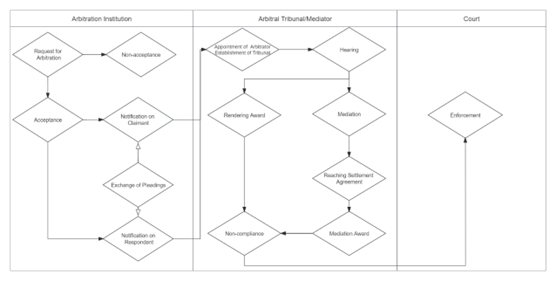
33. What are general steps in the arbitral proceeding?
34. Do arbitral tribunals hear all cases orally?
The arbitration case in principle is heard orally unless otherwise provided in the arbitration agreement by parties or provided in the applicable arbitration rules, for which the arbitration can be a document-only one without oral hearings. For instance, Article 38 of the 2026 BAC Domestic Rules provides that " (4) Where the parties agree that the case shall not be heard by means of oral hearing, or the arbitral tribunal determines that an oral hearing is unnecessary and obtains the parties' consent, the case may be conducted on the basis of documents only according to the parties' written submissions. If a party amends its claim(s) or counterclaim(s) after the oral hearing, the arbitral tribunal may decide whether the amended arbitration claim(s) or counterclaim(s) will be heard on the basis of written submissions according to the specific circumstances of the case."
Unless you and/or the other party explicitly object, the New Arbitration Law expressly affirms that online arbitration proceedings have the same legal validity as offline arbitration proceedings. Most arbitration rules give arbitral tribunal the authority to decide or consult with the parties on mode of hearing. For instance, Article 38 of the 2026 BAC Domestic Rules provides that " (1) An arbitral tribunal shall conduct an arbitration by way of oral hearing. The mode of oral hearing includes an in-person hearing and an online hearing."
35. What is the process of an arbitration hearing?
|
|
|
|
|
|
Notice of hearing
|
The arbitral tribunal notifies the parties of the date of the hearing and the first hearing is required to give advance notice (such time requirement in different arbitration rules would range from 10 days to 20 days).
The parties may request for an adjournment of the hearing with valid reasons within the time limit set by the arbitration rules (usually 5 days). It is up to the arbitral tribunal to decide whether or not to grant an adjournment.
|
Arbitral tribunal → Parties
|
|
|
Housekeeping
|
The arbitral tribunal confirms the identity of the persons present, informs them of their rights and obligations, and briefly introduces members of the arbitral tribunal.
|
Arbitral tribunal → Parties
|
|
|
Statements of the parties
|
The parties presented the claim and defence, counterclaim and defence with reasons to the arbitral tribunal in order.
In order to allow the tribunal to quickly grasp background to the facts and the core arguments of the parties in a shorter period of time, it has now become popular for the parties to make visual presentations with the reasonable use of presentation tools such as PowerPoint.
|
Parties → Arbitral tribunal
|
|
|
Examination of evidence
|
In principle, the parties are required to present their own evidence one by one in the course of the hearing in order to cross-examine evidence presented by the other party on aspects of veracity, legality, relevance and evidential weight.
To save hearing time, with the consent of the parties, the arbitral tribunal may direct parties to check veracity of evidence after the hearing separately. If the parties so agreed, they may check veracity under supervision of the secretary of the arbitration case after the hearing.
Where evidence is submitted in and/or after the hearing, the parties may, if they so agree, submit written cross-examination opinion within a period of time directed by the arbitral tribunal.
|
Parties → Arbitral tribunal
|
|
|
Enquiry by the arbitral tribunal
|
The arbitral tribunal has the right throughout the hearing to question the parties on issues if they are unclear or are interested in, and the parties are obliged to answer.
If any party is difficult to give a direct answer, usually they may request for a written answer after the hearing.
|
Arbitral tribunal → Parties
|
|
|
Summarization of issues in dispute
|
The arbitral tribunal will take into account the previous parts of the hearing as well as written submissions submitted by the parties to summarise issues in dispute for the parties to present arguments. Depending on complexity of the case, the arbitral tribunal may also communicate and consult with the parties in advance on issues in dispute by way of pre-trial meetings, which may save the hearing time as well as avoid the need for multiple hearings to a certain extent.
|
Arbitral tribunal → Parties
|
|
|
Presentation of arguments
|
The parties present their agreements around issues in dispute in order. Depending on the complexity of the case, the arbitral tribunal may direct several rounds of such arguments.
|
Parties → Arbitral tribunal
|
|
|
Closing
|
The parties summarise their overall position and claims to further deepen the arbitral tribunal's understanding of the case.
|
Parties → Arbitral tribunal
|
|
|
Mediation
|
In practice, the arbitral tribunal usually consult with the parties before the closing of the hearings on their intention of mediation. If any party expressly reject to mediate, no mediation will be held.
|
Arbitral tribunal → Parties
|
|
|
Signing the hearing transcript
|
The secretary of the arbitration case or an external stenographer will record the hearing (except for the mediation session) and pass over the hearing transcript to the parties for signing.
|
Arbitral tribunal → Parties
|
36. How does the arbitral tribunal allocate burden of proof between the parties?
Article 55(1) of the New Arbitration Law provides only a principled provision on the burden of proof, i.e., parties shall provide evidence to support their own claims—"he who asserts must prove." Arbitration institutions similarly include principled provisions on the allocation of the burden of proof in their arbitration rules, while providing more specific requirements on time limits for submitting evidence. They may also incorporate by reference guiding rules, such as CIETAC's Guidelines on Evidence, unless the parties agree otherwise.
In practice, if the majority of the arbitral tribunal members have a Mainland China legal education or practice background (i.e., civil law system), the seat of arbitration is in Mainland China, and the substantive law applicable to the case is Chinese law, it is highly likely that the arbitral tribunal will allocate the burden of proof between the parties reasonably, referring to Chinese litigation legal practice and considering the actual circumstances of the case.
37. What is deadline for the arbitral tribunal to render an arbitral award?
The award will usually be made after the conclusion of the hearings yet the specific time for delivering the award shall be considered in context of the arbitration proceedings in accordance with the applicable arbitration rules. Arbitration rules in major institutions prescribe that foreign-related arbitration or international commercial arbitration cases are generally made within six months after the constitution of the arbitral tribunal; domestic arbitration cases within four months and if summary proceedings are applicable, the corresponding period will be even shorter i.e. within two to three months after the constitution of the arbitral tribunal. For instance, Article 64 of the 2026 BAC Domestic Rules provides that " The arbitral tribunal shall render the award within 4 months after its constitution. Where there are special circumstances justifying an extension, the Secretary-General may approve an extension of an appropriate time limit at the request of the presiding arbitrator."
The award is usually made after the conclusion of the hearings. The specific time needs to be determined in conjunction with the arbitration proceedings and the arbitration rules. Generally, according to provisions in arbitration rules, for foreign-related arbitration or international commercial arbitration cases, the award is made within six months after the constitution of the arbitral tribunal; for domestic arbitration cases, generally within four months after the constitution of the arbitral tribunal; if summary procedure applies, the corresponding period is shorter, generally within two to three months after the constitution of the arbitral tribunal. For example, Article 64 of the 2026 BAC Domestic Rules provides: " The arbitral tribunal shall render the award within 4 months after its constitution. Where there are special circumstances justifying an extension, the Secretary-General may approve an extension of an appropriate time limit at the request of the presiding arbitrator."
Mediation
38. Can I request for mediation in arbitration?
Before the arbitral tribunal renders its award, you may request mediation. Mediation proceedings can be organised either by the arbitral tribunal (tribunal mediation) or by a mediator outside the arbitral tribunal (independent mediation). Whichever mode of mediation you choose, the ongoing arbitration proceedings will be suspended until the mediation proceedings conclude (whether successful or unsuccessful). It is important to note that independent mediation requires you to pay separate mediation fees, whereas tribunal mediation does not.
The New Arbitration Law stipulates that if mediation conducted by the arbitral tribunal fails, the tribunal shall render an award without delay; if mediation succeeds, the tribunal shall issue a mediation statement or render an award based on the settlement agreement reached through mediation, both of which have equal legal effect. The mediation statement becomes effective upon signing for receipt by both parties. If a party withdraws its consent before signing for receipt, the arbitral tribunal will render an award promptly.
Independent mediation is mostly found in the arbitration rules of various arbitration institutions. For instance, Article 58 of the 2026 BAC Domestic Rules provides that "(1) During the arbitral proceedings, the parties may reach settlement by themselves or may apply to the Mediation Center of the BAC (the "Mediation Center") for mediation by the mediators of the Mediation Center in accordance with the Mediation Rules of the Mediation Center of the BAC."
39. Does the mediator in a mediation in arbitration have to be an arbitrator?
During the arbitration proceedings, the arbitral tribunal will usually inquire whether the parties are willing to mediate after the conclusion of the hearing. In such circumstances, if all parties are willing to mediate, the mediation will naturally be conducted by the arbitral tribunal itself, with the arbitrators acting as mediators. Of course, the disputing parties may also choose a mediation procedure completely independent of the arbitration. In such a procedure, the mediator would not be the arbitrator hearing the case. Many arbitration institutions have a recommended panel of mediators available for parties to choose from.
40. How exactly does mediation work in arbitration?
The methods and process of mediation in arbitration are quite flexible. Generally, the arbitral tribunal will employ a combination of caucuses and joint sessions to facilitate communication. For example, the tribunal may first communicate separately with each party, then convene them for joint discussions, or conduct the entire process through separate communications. Throughout this process, the tribunal seeks to fully understand the genuine interests and concerns of each party.
Since the arbitral tribunal has already thoroughly heard the parties' arguments by the conclusion of the hearing, when acting as mediators, they can not only appropriately express their preliminary views on the parties' claims from an arbitrator's perspective but also leverage their extensive experience to propose potential solutions and guide the parties to consider future interests and cooperation. In short, this comprehensive approach often achieves relatively good results in resolving disputes. In arbitration practice, a considerable number of disputes are successfully mediated on the very day of the hearing.
If mediation succeeds, the parties may choose to withdraw the arbitration application or request the arbitral tribunal to issue a mediation statement or render an award based on the settlement agreement or result. If mediation fails, the arbitration proceedings will continue. It is important to note that the parties may not invoke in subsequent arbitration proceedings, judicial proceedings, or any other proceedings any statements, opinions, views, or proposals made by the other party or the arbitral tribunal during the mediation process as a basis for their claims, defenses, or counterclaims.
Topic 5: Enforcement and Setting Aside of Awards
Relief Channels
41. When does an arbitration award become legally effective?
An arbitration award becomes legally effective from the date on which it is made and is legally binding on all parties to the arbitration. If a settlement agreement is reached through mediation during arbitration, the arbitral tribunal shall issue a mediation statement or make an award based on the terms of the settlement agreement. A mediation statement becomes legally effective only after it has been acknowledged and received by both parties. If a party retracts their consent before acknowledging receipt of the mediation statement, the arbitral tribunal shall promptly render an award. The award shall be signed by the arbitrators and affixed with the seal of the arbitration institution. Arbitrators with dissenting opinions regarding the award may or may not sign it.
42. What legal remedies are available if I am not satisfied with the arbitration result?
You may apply to have the arbitration award set aside or apply for non-enforcement during the enforcement proceedings of the award. If you choose to apply to set aside the award, you must file the application within three months from the date of receiving the award. The people's court shall, within two months from the date of accepting the application to set aside the award, render a ruling either setting aside the award or dismissing the application. If you choose to apply for non-enforcement of the arbitration award, you must submit a written application to the enforcing court within fifteen days from the date of receiving the enforcement notice. It is important to note that if the party entitled to enforcement does not apply for enforcement, you cannot apply for non-enforcement of the award. During the enforcement proceedings, if you have applied to set aside the arbitration award and such application has been accepted by the competent court, or if you have filed an application for non-enforcement and provided appropriate security, the enforcing court shall rule to suspend enforcement of the award. It is important to note that if you apply for non-enforcement of a mediation statement issued in arbitration or an arbitration award made based on a settlement agreement or mediation agreement, the people's court will not support such application, unless such mediation statement or arbitration award violates public interests.
43. If I am not satisfied with the arbitration result, can I apply for re-arbitration?
Re-arbitration is a special procedure ancillary to the arbitration award setting-aside proceedings. You cannot directly apply for re-arbitration, but you may apply to set aside the arbitration award. After the people's court accepts the application to set aside the award, if it considers that the matter may be referred back to the arbitral tribunal for re-arbitration, it shall notify the arbitral tribunal to conduct re-arbitration within a specified time limit and rule to suspend the setting-aside proceedings. If the arbitral tribunal commences re-arbitration, the people's court shall rule to terminate the setting-aside proceedings. If the arbitral tribunal refuses to conduct re-arbitration, the people's court shall rule to resume the setting-aside proceedings.
Circumstances under which the people's court may notify the arbitral tribunal to conduct re-arbitration include: (1) the evidence on which the arbitration award is based is forged; (2) the other party has concealed evidence sufficient to affect the impartiality of the award. In practice, to support arbitration, the initiation of re-arbitration is not limited to the aforementioned statutory circumstances. People's courts also tend to notify arbitral tribunals to conduct re-arbitration in situations such as where the tribunal has exceeded its scope of authority, providing the tribunal with an opportunity for self-correction.
It is important to note that re-arbitration proceedings are still conducted by the original arbitral tribunal, and the scope of the tribunal's review shall focus on the defects in the award as identified by the people's court. In principle, parties may not add or waive part of their arbitration claims or raise counterclaims during re-arbitration. Nor may they withdraw their original arbitration application unless all parties agree thereto or such withdrawal does not prejudice the interests of others.
If a party is dissatisfied with the re-arbitration award, they may apply to set aside such re-arbitration award within three months from the date of service of the re-arbitration award.
Enforcement of Award
44. Which people's court should I apply to for enforcement of an arbitration award?
For awards made in Mainland China, you may apply for enforcement to the intermediate people's court in the place of domicile of the party against whom enforcement is sought or in the place where the property subject to enforcement is located. If the amount subject to enforcement falls within the scope of jurisdiction by level for first-instance civil and commercial cases accepted by a basic people's court, and the domicile of the party against whom enforcement is sought or the location of the property subject to enforcement is within the jurisdiction of a designated basic people's court, the intermediate people's court may, upon approval by the higher people's court, designate the basic people's court to have jurisdiction. If a foreign-related award is made within Mainland China, and the party against whom enforcement is sought or its property is not located within the Mainland China, you may apply to a competent court abroad for recognition and enforcement of the award. In such circumstances, which specific court has jurisdiction shall be determined in accordance with the procedural laws of the local court.
For foreign awards, similarly, you may directly apply to the intermediate people's court in the place of domicile of the party against whom enforcement is sought or in the place where its property is located for recognition and enforcement. If the domicile of the party against whom enforcement is sought or its property is not located within Mainland China, you may apply to the intermediate people's court in your place of domicile or in a place having appropriate connection with the dispute under the award. The people's court shall handle such matters in accordance with international treaties concluded or acceded to by the People's Republic of China or based on the principle of reciprocity. If foreign arbitration institutions impose restrictions on or discriminate against the lawful rights and interests of Chinese citizens, legal persons, or other organisations, relevant Chinese authorities shall have the right to apply the principle of reciprocity to citizens, enterprises, and other organizations of such foreign countries.
For awards made in the Hong Kong and Macao Special Administrative Regions, you may apply to the intermediate people's court in the place of domicile of the party against whom enforcement is sought or in the place where its property is located for recognition and enforcement. It is important to note that if the domicile of the party against whom enforcement is sought or the location of its property is within the jurisdiction of different intermediate people's courts in Mainland China, you may choose one of these people's courts to apply for enforcement of the award and shall not submit applications to two or more people's courts simultaneously. If the party against whom enforcement is sought has domicile or executable property in both Mainland China and Hong Kong, you may apply for enforcement to the courts in both places separately. Upon request by the courts in the other jurisdiction, the courts in both places shall mutually provide information regarding the enforcement of the arbitration award in their respective jurisdictions, and the total amount of property enforced by the courts in both places shall not exceed the amount determined in the award.
For awards made in the Taiwan Region, you may apply to the intermediate people's court or a specialised people's court in your place of domicile, habitual residence, or the place of domicile, habitual residence, or property location of the party against whom enforcement is sought for recognition. After the award is recognised, it shall be enforced by the enforcement organs of the people's court.
45. Under what circumstances will a people's court refuse to enforce an arbitration award?
For foreign-related awards made in Mainland China, where the applicant adduces evidence, circumstances under which the people's court shall rule not to enforce the award include: (1) the absence of an arbitration agreement; (2) the party against whom enforcement is sought was not given proper notice of the appointment of an arbitrator or of the arbitration proceedings, or was otherwise unable to present its case due to reasons not attributable to such party; (3) the composition of the arbitral tribunal or the arbitration procedure was not in accordance with the arbitration rules; (4) the matters decided in the award exceed the scope of the arbitration agreement or the arbitration institution has no power to arbitrate. If the people's court determines that enforcement of the award would be contrary to public interest, it shall rule not to enforce the award.
For non-foreign-related awards made in Mainland China, where the applicant adduces evidence, circumstances under which the people's court shall rule not to enforce the award include: (1) the absence of an arbitration agreement; (2) the matters decided in the award exceed the scope of the arbitration agreement or the arbitration institution has no power to arbitrate; (3) the composition of the arbitral tribunal or the arbitration procedure violated statutory procedures; (4) the evidence on which the award is based is forged; (5) the other party has concealed evidence sufficient to affect the impartiality of the award; (6) the arbitrators, during arbitration of the case, committed acts of soliciting or accepting bribes, engaging in malpractice for personal gain, or perverting the law in making the award. If the people's court determines that enforcement of the award would be contrary to public interest, it shall rule not to enforce the award.
For foreign awards, if the award was made in a New York Convention member state, the people's court shall primarily determine whether to recognise and enforce the award based on the New York Convention. In layman's terms, circumstances for the court to refuse recognition and enforcement mainly include: (1) the absence of a valid arbitration agreement; (2) lack of proper notice resulting in the party being unable to present its case; (3) the award exceeds the scope of arbitration claims; (4) the procedure was not in accordance with the arbitration rules or the law of the place of arbitration; (5) the award is not yet binding; (6) the subject matter of the dispute is not arbitrable; (7) the award is contrary to public policy/interest. If the award was made in a non-New York Convention member state, the people's court shall handle the matter based on the principle of reciprocity. For awards made in Hong Kong, Macao Special Administrative Regions, and Taiwan Region, the circumstances for non-recognition and non-enforcement are generally similar to those under the New York Convention.
46. If I am not satisfied with the people's court's ruling not to enforce an arbitration award, can I appeal?
For the enforcement of awards made in Mainland China, if the people's court rules not to enforce the award, dismisses, or refuses to accept an application for non-enforcement of the arbitration award, and you apply for reconsideration or raise an enforcement objection, the people's court shall not accept such application. However, you may re-apply for arbitration based on a written arbitration agreement reached by both parties, or you may directly initiate litigation.
For the recognition and enforcement of foreign awards, a ruling made by the people's court becomes legally effective upon service. If a party applies for reconsideration, appeals, or applies for retrial regarding such ruling, the people's court shall generally not accept such application. However, there are exceptional circumstances. For example, if the relevant ruling was made without submission to the higher people's court or the Supreme People's Court for review as required, and if the ruling is indeed erroneous, the people's court may, on its own authority, correct the erroneous ruling through trial supervision procedures.
Setting Aside of an Award
47. Which people's court should I apply to for setting aside an arbitration award?
For awards made by arbitration institutions in Mainland China, you may apply to the intermediate people's court in the place where the arbitration institution is located to set aside the award. For foreign-related awards made by foreign arbitration institutions within Mainland China, you may apply to the intermediate people's court at the place of arbitration to set aside the award.
48. Under what circumstances will a people's court set aside an arbitration award?
For non-foreign-related awards, where the applicant adduces evidence, circumstances under which the people's court shall set aside the award include: (1) the absence of an arbitration agreement; (2) the matters decided in the award exceed the scope of the arbitration agreement or the arbitration institution has no power to arbitrate; (3) the composition of the arbitral tribunal or the arbitration procedure violated statutory procedures; (4) the evidence on which the award is based is forged; (5) the other party has concealed evidence sufficient to affect the impartiality of the award; (6) the arbitrators, during arbitration of the case, committed acts of soliciting or accepting bribes, engaging in malpractice for personal gain, or perverting the law in making the award. If the people's court determines that the award is contrary to public interest, it shall rule to set aside the award. It is important to note that if you apply to set aside an award on grounds other than those provided by law, the court will generally not support such application.
For foreign-related awards, where the applicant adduces evidence, circumstances under which the people's court shall set aside the award include: (1) the absence of an arbitration agreement; (2) the party was not given proper notice of the appointment of an arbitrator or of the arbitration proceedings, or was otherwise unable to present its case due to reasons not attributable to such party; (3) the composition of the arbitral tribunal or the arbitration procedure was not in accordance with the arbitration rules; (4) the matters decided in the award exceed the scope of the arbitration agreement or the arbitration institution has no power to arbitrate. If the people's court determines that enforcement of the award would be contrary to public interest, it shall rule to set aside the award.
49. How long does the procedure for setting aside an arbitration award typically take?
The people's court shall, within two months from the date of accepting the application to set aside the award, render a ruling either setting aside the award or dismissing the application. In practice, some people's courts that are arbitration-friendly and experienced may take even less time.
50. What legal remedies do I have against a ruling setting aside an arbitration award?
A ruling made by the people's court setting aside an arbitration award becomes legally effective upon service. You may not apply for reconsideration, appeal, or apply for retrial regarding such ruling. If procuratorial authorities raise a protest against such ruling, the court shall also not accept it.
If such ruling is indeed erroneous and was made without submission to the higher people's court or the Supreme People's Court for review as required, legal remedies are still available. For example, the people's court may, on its own authority, correct the erroneous ruling through trial supervision procedures.